How to Run Facebook Ads for Dropshipping in 2026
Run Facebook Ads for Dropshipping in 2026. Easy Step-by-Step Guide for drop shipping(7 is ***)
Angelina Markells
3/28/20265 min read
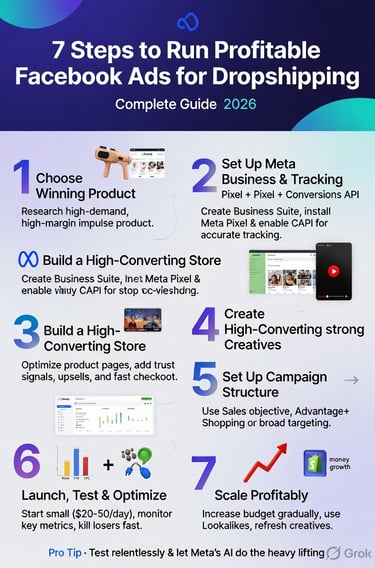
How to Run Facebook Ads for Dropshipping in 2026: Complete 7 Easy Step-by-Step Guide(7 is ***)
Facebook (now Meta) Ads remain one of the most powerful traffic sources for dropshipping businesses. With billions of active users on Facebook and Instagram, you can reach highly targeted audiences and scale profitable stores quickly—if you do it right.
In 2026, success with Facebook Ads for dropshipping relies on strong creatives, accurate tracking (especially Conversions API), broad targeting with Advantage+ features, and relentless testing. This comprehensive guide walks you through everything from setup to scaling, helping beginners and intermediate dropshippers launch and optimize campaigns effectively.
Why Facebook Ads Work So Well for Dropshipping
Dropshipping has low overhead—no inventory to manage—so advertising is where most of your budget goes. Facebook Ads excel here because:
Precise (or broad + AI-powered) targeting reaches impulse buyers.
Visual platforms (Facebook + Instagram) suit product demonstration videos and images.
Fast testing: Validate products with small budgets before scaling.
Retargeting warms up cold traffic for higher conversions.
Integration with Shopify via Meta Pixel and Catalog makes dynamic ads easy.
Many successful dropshippers achieve 3x–5x ROAS (Return on Ad Spend) when following structured strategies.
Prerequisites Before Running Facebook Ads
Before spending a dollar:
Choose a Winning Product: Focus on items with visual appeal, problem-solving benefits, and impulse-buy potential (e.g., gadgets, beauty tools, home accessories). Use tools like AliExpress, CJDropshipping, or trend research for validation. Ensure fast shipping and good supplier reliability.
Build a Professional Store: Use Shopify. Optimize product pages with high-quality images, clear descriptions, trust badges, and fast loading. Add upsells and a smooth checkout.
Set Up a Facebook Business Page: Create a dedicated Page for your brand (not personal profile).
Verify Your Domain: In Meta Business Suite, verify your website domain for better ad delivery and tracking.
Step 1: Set Up Your Meta Business Suite and Ad Account
Go to business.facebook.com and create a Meta Business Suite account.
Add your Facebook Page and Instagram account (if using).
Create an Ad Account.
Add a payment method (credit card or PayPal).
Set up your Business Manager with proper roles for security.
Pro Tip: Use a clean ad account. Avoid sharing accounts or using VPNs that trigger restrictions. Comply with Meta's advertising policies—avoid misleading claims, prohibited products, or fake scarcity.
Step 2: Install Tracking – Meta Pixel + Conversions API (CAPI)
Accurate tracking is critical in 2026 due to privacy changes (iOS, ad blockers).
In Shopify, go to Online Store > Preferences > Install the Meta Pixel via the official Facebook & Instagram sales channel.
Enable Conversions API (CAPI) for server-side tracking. This sends purchase data directly to Meta, bypassing browser limitations and improving attribution by 30-40%.
Set up standard events: PageView, AddToCart, InitiateCheckout, Purchase.
Verify the Pixel in Meta Events Manager.
Without proper tracking, your campaigns will optimize poorly, wasting money.
Step 3: Understand Campaign Structure in 2026
Modern best practice simplifies structure thanks to Meta's AI (Advantage+):
Campaign Level: Choose objective → Sales (or Conversions for purchase optimization).
Ad Set Level: Use Advantage+ Shopping Campaign (ASC) or broad targeting. Many experts recommend 100% broad (no detailed interests) + let Meta's algorithm find buyers. Set age, gender (if relevant), and locations (e.g., US, UK, CA for English-speaking markets).
Ad Level: Test multiple creatives (3–5 per ad set). Use images, videos, carousels, or Reels-style short videos.
Budget Recommendation for Beginners:
Start with $20–50/day per campaign for testing.
Test for 3–7 days before judging.
Step 4: Create High-Converting Ad Creatives
Creatives make or break dropshipping ads. Focus on hooks in the first 3 seconds.
Best Practices for 2026:
Use UGC (User-Generated Content) style: Real-looking videos of people using the product.
Highlight benefits, not just features (e.g., “Relieve back pain in minutes” instead of “Ergonomic cushion”).
Add text overlays, urgency (“Limited stock”), and clear CTAs (“Shop Now”).
Formats that work well: Short videos (15–30s), before/after, testimonials, problem-solution.
Mobile-first: Most traffic comes from phones.
Test variations: Different hooks, angles, music, and thumbnails.
Ad Copy Tips:
Headline: Attention-grabbing question or bold claim.
Primary Text: Tell a story or address pain points.
Description: Social proof or offer details.
Tools like CapCut or Canva help create ads quickly.
Step 5: Targeting Strategies That Work in 2026
Broad Targeting: Let Meta's algorithm optimize. Many successful campaigns run with minimal restrictions (just country + age).
Lookalike Audiences: Once you have 100+ purchases, create 1% Lookalikes from buyer lists for scaling.
Retargeting: Essential for profits. Target website visitors, AddToCart users, video watchers (50%+ viewed), and past purchasers.
Advantage+ Audience: Meta's automated option—often outperforms manual detailed targeting.
Avoid over-narrowing early on; it limits learning.
Placements: Use Advantage+ Placements (Facebook Feed, Instagram Feed/Reels/Stories, Audience Network). Manual selection can work but AI usually does better.
Step 6: Launch, Monitor, and Optimize Your Campaigns
Create the campaign in Ads Manager.
Set daily or lifetime budget.
Publish and wait for data (give it 24–72 hours).
Key Metrics to Watch:
CTR (Click-Through Rate): >1–2% is decent.
CPC (Cost Per Click): Depends on niche; lower is better.
ROAS: Aim for 3x+ to cover product costs, ads, and profit.
CPM (Cost Per Mille): Monitor for rising costs.
Conversion Rate: From your store analytics.
Optimization Rules:
Kill underperforming ads/creatives quickly.
Scale winners by increasing budget 20–50% every few days (if ROAS holds).
Duplicate winning ad sets for scaling.
Use A/B testing for creatives and audiences.
Step 7: Scaling Facebook Ads Profitably
Once you have a winner:
Increase budget gradually to avoid algorithm reset.
Create new campaigns with Lookalikes.
Expand to more products or geographies.
Add retargeting campaigns for higher ROAS.
Test Advantage+ Shopping Campaigns for catalog-based scaling.
Monitor for ad fatigue—refresh creatives every 1–2 weeks.
Common Mistakes to Avoid with Facebook Ads for Dropshipping
Poor product choice (no demand or bad margins).
Weak store experience (slow loading, no trust signals).
Relying only on Pixel without CAPI.
No testing—launching one creative and expecting results.
Scaling too fast on unproven ads.
Ignoring policies (banned for misleading claims or IP issues).
Not monitoring daily—ads can burn budget quickly.
Bad creatives (stock photos instead of authentic videos).
Advanced Tips for 2026 Success
Leverage Dynamic Product Ads (DPA) for retargeting catalog items.
Use content marketing (organic posts, TikTok/Instagram Reels) to warm audiences before ads.
Combine with email/SMS marketing for repeat buyers.
Analyze competitor ads via tools like Meta Ad Library.
Focus on high-margin products to survive rising ad costs.
Conclusion: Start Small, Test Relentlessly, Scale Smart
Running Facebook Ads for dropshipping isn't "set and forget." It requires ongoing optimization, creative testing, and data-driven decisions. In 2026, the winners combine strong offers, authentic creatives, and Meta's AI tools while maintaining solid tracking.
Begin with a small budget on one product, track everything, and iterate. Many stores go from $0 to $10k+/month by mastering this process.
Ready to launch? Head to Meta Ads Manager and set up your first campaign today. If you're serious about scaling, consider learning from case studies or joining dropshipping communities for real-time insights.
Frequently Asked Questions
How much budget do I need to start? $300–1000 for initial testing is realistic.
Do Facebook Ads still work in 2026? Yes—especially with proper setup and creative focus. Broad + AI strategies are performing well.
What if my ads get disapproved? Check policy violations. Appeal or edit (common issues: before/after claims, health claims).
Should I use interests or broad? Broad or Advantage+ often wins in 2026 for cold traffic.
Success comes from consistency. Test, learn from data, and refine your approach. Good luck with your dropshipping journey!