High Paying Jobs in 2030: Best Career Options for the Future
Looking for high-paying jobs in 2030? This guide covers top careers, expected salaries, and the skills you need to succeed in the future job market.
Angelina Markells
4/3/20264 min read
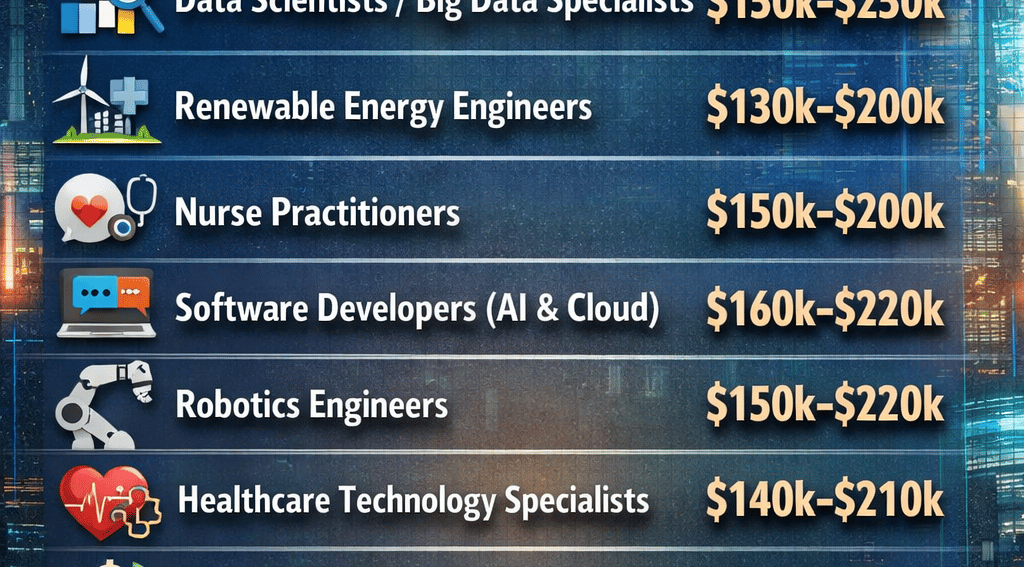
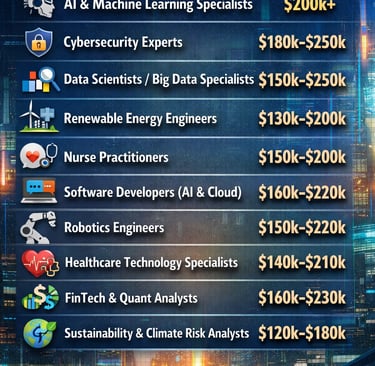
Top 10 High-Paying Jobs in 2030: Future-Proof Careers You Should Prepare for Today
As we move deeper into the digital age, the global job market is transforming at an unprecedented pace. The year 2030 may seem far away, but the skills you build today will determine your success tomorrow. Rapid advancements in artificial intelligence, climate initiatives, cybersecurity, and healthcare are reshaping industries across the world.
According to global workforce reports and projections, the future belongs to professionals who combine technical expertise with adaptability, creativity, and strategic thinking. If you're a student, job seeker, or working professional planning your next move, understanding future career trends is not optional—it’s essential.
In this blog, we explore the top 10 high-paying jobs in 2030, why they matter, the skills required, and how you can start preparing today.
1. AI and Machine Learning Specialists
Artificial Intelligence (AI) is no longer just a buzzword—it is becoming the backbone of modern industries. From healthcare diagnostics to self-driving cars, AI is revolutionizing how businesses operate.
AI and Machine Learning specialists are responsible for designing intelligent systems that can learn, predict, and automate tasks. Their work directly impacts decision-making processes across industries.
Why it pays well:
Companies are investing heavily in AI to gain a competitive edge. Skilled professionals are scarce, making them highly valuable.
Projected Salary (2030): $200,000+
Skills Required:
Machine Learning frameworks (TensorFlow, PyTorch)
Python programming
Data modeling and algorithms
AI ethics and governance
How to prepare:
Start learning Python, work on real-world AI projects, and enroll in specialized courses or certifications.
2. Cybersecurity Experts
As the world becomes more digital, cyber threats are increasing rapidly. From data breaches to ransomware attacks, organizations face constant risks.
Cybersecurity experts protect systems, networks, and data from attacks. Their role is critical in maintaining trust and business continuity.
Why it pays well:
Cybersecurity is a necessity, not an option. Every company needs protection.
Projected Salary (2030): $180,000–$250,000+
Skills Required:
Ethical hacking
Network security
Cloud security
Risk management
How to prepare:
Obtain certifications like CEH, CISSP, or CompTIA Security+ and practice penetration testing.
3. Data Scientists and Big Data Specialists
Data is often called the “new oil.” Organizations rely on data-driven decisions to stay competitive.
Data scientists analyze massive datasets to extract insights that help businesses grow, reduce costs, and improve efficiency.
Why it pays well:
Every industry—from retail to healthcare—depends on data.
Projected Salary (2030): $150,000–$250,000
Skills Required:
Python, R, SQL
Data visualization tools
Statistics and analytics
Machine learning basics
How to prepare:
Build a portfolio using platforms like Kaggle and work on real-life datasets.
4. Renewable Energy Experts
With climate change becoming a global concern, countries are investing in clean energy sources like solar, wind, and hydrogen.
Renewable energy experts design, implement, and manage sustainable energy systems.
Why it pays well:
Governments and corporations are pushing for net-zero emissions.
Projected Salary (2030): $130,000–$200,000+
Skills Required:
Energy system design
Environmental engineering
Sustainability analytics
Project management
How to prepare:
Study environmental engineering or renewable energy courses.
5. Advanced Healthcare Professionals
Healthcare is evolving with technology. With an aging population and rising health awareness, the demand for skilled professionals is increasing.
Nurse practitioners and advanced healthcare professionals provide specialized care and often work independently.
Why it pays well:
Healthcare demand is always high and growing.
Projected Salary (2030): $150,000–$200,000+
Skills Required:
Clinical expertise
Patient care technologies
Telemedicine knowledge
How to prepare:
Pursue higher education in nursing or healthcare specialization.
6. Software Developers (AI & Cloud Focus)
Software developers continue to be in high demand, especially those skilled in AI and cloud technologies.
They build applications, systems, and platforms that power businesses worldwide.
Why it pays well:
Digital transformation is accelerating across industries.
Projected Salary (2030): $160,000–$220,000
Skills Required:
Programming languages (JavaScript, Python, Java)
Cloud platforms (AWS, Azure)
DevOps practices
AI integration
How to prepare:
Work on real projects, contribute to open-source, and build applications.
7. Robotics Engineers
Robotics is transforming industries such as manufacturing, healthcare, and logistics.
Robotics engineers design machines that can perform tasks automatically and efficiently.
Why it pays well:
Automation is replacing manual labor in many sectors.
Projected Salary (2030): $150,000–$220,000+
Skills Required:
Robotics programming
Sensor technology
Control systems
AI integration
How to prepare:
Learn robotics frameworks like ROS and work on hardware projects.
8. Healthcare Technology Specialists
This role combines healthcare and technology, focusing on improving medical systems through data and AI.
These professionals manage health data, develop medical software, and improve patient care systems.
Why it pays well:
The fusion of healthcare and technology is rapidly expanding.
Projected Salary (2030): $140,000–$210,000
Skills Required:
Health informatics
Data privacy regulations
AI in medicine
System integration
How to prepare:
Study both healthcare and IT-related subjects.
9. FinTech Engineers and Quantitative Analysts
Finance is undergoing a digital revolution with blockchain, digital payments, and algorithmic trading.
FinTech engineers build financial systems, while quantitative analysts use math and data to predict market trends.
Why it pays well:
Finance + Technology = High value.
Projected Salary (2030): $160,000–$230,000
Skills Required:
Blockchain technology
Financial modeling
Programming (Python, C++)
Data analysis
How to prepare:
Learn financial systems, coding, and blockchain basics.
10. Sustainability and Climate Risk Analysts
Companies are now required to measure and reduce their environmental impact.
Sustainability analysts help organizations manage climate risks and follow ESG (Environmental, Social, Governance) standards.
Why it pays well:
Sustainability is becoming mandatory globally.
Projected Salary (2030): $120,000–$180,000+
Skills Required:
Climate modeling
Carbon accounting
Risk assessment
ESG frameworks
How to prepare:
Take courses in sustainability and environmental science.
Why These Jobs Will Dominate by 2030
These careers are not random—they are driven by major global trends:
1. Technology Growth
AI, automation, and data are transforming every industry.
2. Climate Change
Sustainability is no longer optional—it’s a global priority.
3. Healthcare Demand
An aging population requires advanced medical care.
4. Cybersecurity Needs
Digital threats are increasing every day.
5. Financial Evolution
Digital finance and blockchain are reshaping economies.
The Skills You Must Build Today
To succeed in these future careers, focus on:
Technical Skills: Coding, AI, data analysis
Soft Skills: Communication, problem-solving
Adaptability: Learn continuously
Digital Literacy: Understand emerging technologies
Reports suggest that nearly 39% of current skills will change by 2030 . This means lifelong learning is essential.
Final Thoughts
The future job market is full of opportunities—but only for those who are prepared.
The key takeaway is simple:
👉 Don’t wait for the future—start building it today.
Whether you're a student choosing a career path or a professional planning a switch, aligning your skills with future demand will give you a strong advantage.
Success in 2030 will not depend on what you studied in the past—but on how quickly you adapt, learn, and grow.